Not all vegetation is equally dangerous. For acreage owners in Princeton, Penticton, and the surrounding Similkameen and South Okanagan, this guide explains exactly which plants to target first, why ladder fuels matter more than tree count, and how the work should be done to actually reduce wildfire risk.
What specific vegetation should I target during land clearing for fire mitigation in Princeton and Penticton?
The first priority is ladder fuels — the low-hanging branches (under 2 meters), tall cured grasses, and dense shrubs that allow a ground fire to climb into the tree canopy. In Princeton and Penticton, that means pruning all live branches from 0 to 2 meters on retained trees, cutting back the dense stands of saskatoon, snowberry, and rabbitbrush that dominate dry south-facing slopes, and mowing down the annual cheatgrass and knapweed that carry flame fast across open ground. Once the ladder is broken, thin the smaller conifers (under roughly 5 inches diameter) so crowns stay separated, and clear the fine surface fuels — needles, twigs, and bark — from within 1.5 meters of any structure. For most acreage owners in the Similkameen and South Okanagan, a professional fire mitigation assessment confirms exactly which species on your lot need to go, which should be pruned, and which are worth keeping for shade and slope stability.
Princeton and Penticton sit in one of the driest, most fire-prone corridors in British Columbia. Penticton averages well over 300 mm of annual precipitation in a good year and often far less, tucked into the rain shadow of the Coast Mountains at the south end of Okanagan Lake. The surrounding hillsides — from the Skaha Bluffs down through Kaleden and Okanagan Falls — are dominated by open ponderosa pine and Douglas-fir with a sun-baked understory of grass and shrubs. Princeton, sitting at the confluence of the Tulameen and Similkameen rivers, is surrounded by steep, forested slopes that funnel wind and dry out fast in July and August.
Both communities have lived through it. The 2021 White Rock Lake fire tore through the hills above the North Westside and forced evacuations across the region; Princeton has seen repeated close calls and interface fires driven by wind pushing up the valley. What those events demonstrated to every acreage owner in the Similkameen and South Okanagan is that the danger is rarely the big trees themselves — it's the continuous carpet of grass, shrubs, and low branches that carries a fire from the roadside right up to a home's deck.
Add the realities of these locations: steep terrain that fire climbs faster than it travels on flat ground (see our complete Okanagan fire mitigation guide for more on how topography drives fire behaviour), limited egress roads on rural acreages, and dry, curing grass that ignites from a single spark in late summer. This is exactly why the clearing priorities described below are not cosmetic landscaping advice — they're the difference between a property that survives a wind-driven ember shower and one that doesn't.
The key insight for Princeton and Penticton acreage owners
You do not need to clear every tree to be fire-safe. You need to break the vertical and horizontal continuity of fuel so fire has nowhere to climb and nowhere to travel. That's a targeted job, done in the right order — and it's far cheaper than blanket clearing.
A wildfire spreads through three layers of fuel: the surface layer (grass, needles, twigs, bark), the shrub and understory layer, and the canopy layer (tree crowns). In a healthy, fire-resilient forest these layers are separated by gaps. Fire has to work hard to move from one to the next.
Ladder fuels are what close those gaps. They are the low-hanging branches (anything under about 2 meters), tall dry grasses, and dense shrubs that let a ground fire "climb" step by step into the tree canopy like a ladder. Once flame reaches the crowns, the fire stops being a slow-moving ground fire and becomes a running crown fire — hotter, faster, unpredictable, and nearly impossible to suppress. Embers then shower down hundreds of meters ahead, igniting spot fires on the next property.
On a Similkameen or South Okanagan acreage, ladder fuels typically look like this: a mown strip along the road, then chest-high dry grass, then a tangle of saskatoon and snowberry, then Douglas-fir branches starting at knee height, and finally a closed canopy. That is a complete, unbroken ladder — and it's the single most important thing to correct on any fire mitigation project.
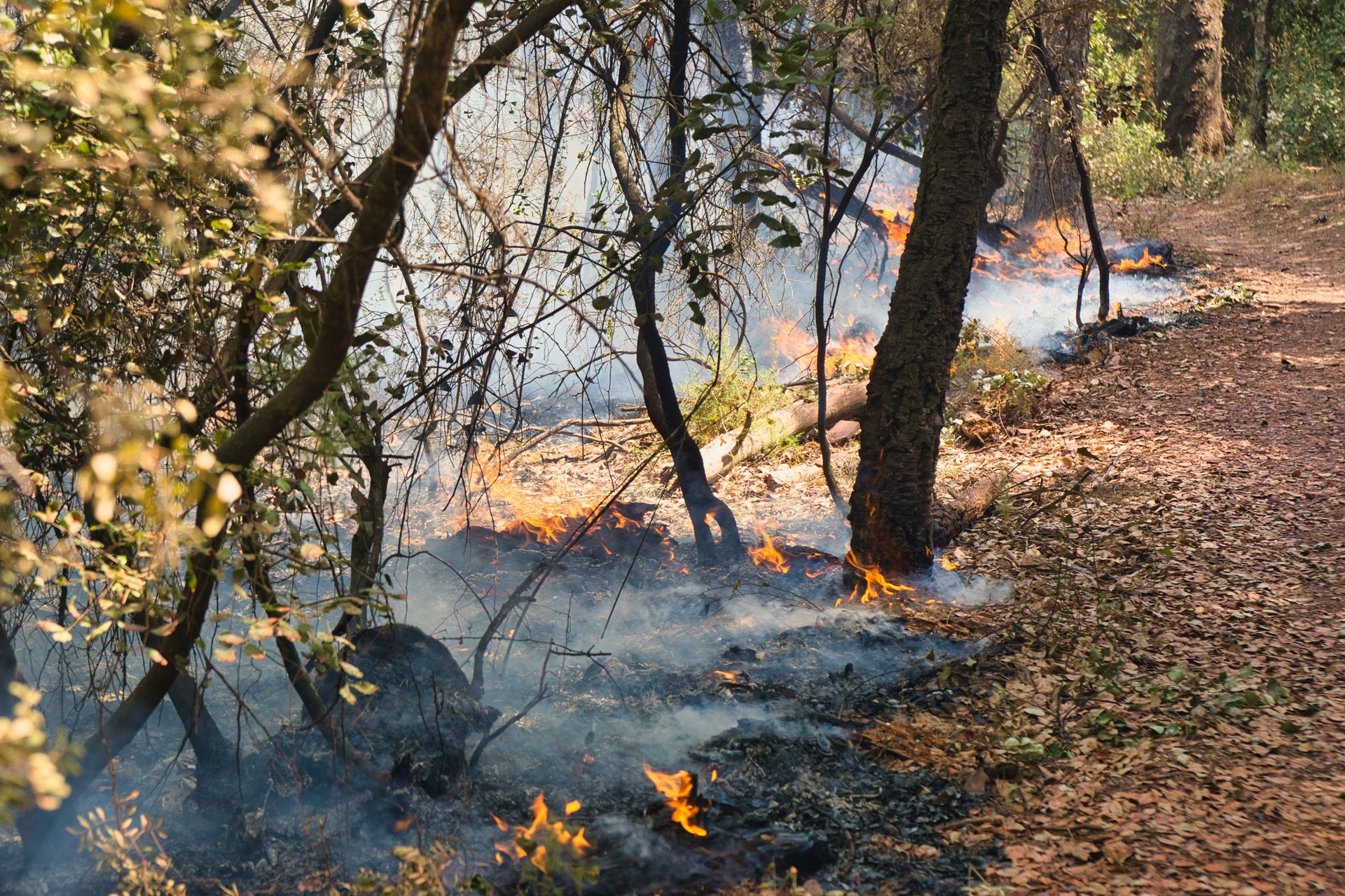
Separating grass, shrubs, and tree crowns breaks the ladder a fire climbs
Not every plant on your property deserves the same urgency. A professional fire mitigation plan for a Princeton or Penticton acreage works in a deliberate sequence — highest risk first, always starting closest to the structures where lives and property are most exposed. Here is the order we use, and the reasoning behind each step.
This is the first and most impactful cut on any property. Lift all live branches on retained trees to a minimum of 2 metres from the ground. On steep slopes — very common around Princeton and above the Penticton benchlands — increase that clearance, because fire moving uphill reaches higher. Do not remove more than roughly one-third of a tree's live crown in a single session; over-pruning stresses conifers and can kill them. Prune in late fall or winter where possible. This single step removes the top rung of the ladder and lets a ground fire pass underneath your valuable trees without torching them.
Fine, cured grass is the fastest-moving fuel on the landscape and the number one reason fires reach homes in the South Okanagan. Cheatgrass, knapweed, and the tall annual grasses that cure to a straw colour by late June ignite instantly from a vehicle exhaust pipe, a mower blade strike, or a cigarette. Ongoing vegetation management is how you keep those fuels from returning year after year. Within 10 metres of any structure, mow to 10 cm or less and keep it mown through fire season. Beyond that, mow strategic strips and maintain them as fuel breaks. Timing matters: mow in spring or early summer while grasses are still green, and never mow dry grass on a hot, windy afternoon with metal blades on rocky ground.
Thick shrub communities form a continuous horizontal fuel bed and a mid-height ladder rung at the same time. In the Similkameen and South Okanagan this usually means saskatoon, snowberry, rabbitbrush, ocean spray, and ninebark, often interwoven with young Douglas-fir and pine regeneration. Thin shrubs so that individual plants are separated by roughly twice their height, and remove the thickest blocks entirely near structures and along access roads. Retain clumps on erodible slopes and around gullies where root systems hold soil — that's a judgement call best made on site with someone who knows the terrain.
Young, dense conifer regeneration is essentially standing kindling — a continuous wall of resin-rich fuel from ground to tip. Remove the majority of trees under roughly 5 inches (12.5 cm) at the base, especially the "doghair" thickets of lodgepole pine and Douglas-fir that colonize after disturbance. Space remaining trees so crowns are separated by at least 3 metres, and much more on steep ground where fire runs uphill. Keep the larger, thicker-barked, well-spaced trees — mature ponderosa pine in particular is one of the most fire-resistant species in BC, and it's the backbone of a fire-resilient stand.
Within 1.5 metres of your foundation and under decks and porches, remove all needle litter, twigs, bark, and bark mulch. Embers — not flame fronts — destroy most homes in interface fires, and they collect exactly in those fine-fuel pockets. Keep the first 10 metres around any structure essentially bare of combustible ground cover, using gravel, rock, or irrigated low-growing plants instead. Clean gutters, and clear accumulated needles off roofs. This step costs almost nothing and delivers outsized protection.
Standing dead trees, fallen beetle-killed pine, brush piles, and stacked firewood are pre-dried fuel. Remove dead standing trees within falling distance of structures or access routes, chip or haul slash, and relocate firewood at least 10 metres from the house and outbuildings. Burning slash piles is a poor option in this region — it creates a smoke nuisance, requires permits and safe conditions, and leaves blackened scars. Forestry mulching on site is faster, cleaner, and returns carbon to the soil.
Work from the house outward — always
If you can only afford part of the job this year, spend it here: the first 10 metres around your home and outbuildings in Princeton or Penticton delivers more protection per dollar than anything else on your property. Once that ring is done, extend outward in bands.
A common mistake on BC acreages is treating all vegetation as equally dangerous — or, just as often, being reluctant to cut anything at all. Fire behaviour differs enormously by species. Here's how we think about the plants you'll actually find on properties around Princeton and Penticton.
Species composition varies dramatically between a north-facing slope above Princeton, a benchland lot in Penticton, and a creek-bottom acreage in between. Always confirm identification and local priorities during an on-site assessment rather than working from a general list.
Knowing what to cut is half the job. How you cut it determines whether the work holds up for a decade or creates a mess you have to manage again in two years. On Princeton and Penticton acreages, our approach favours mechanical treatment over burning and hauling — it's faster, cleaner, emits far less smoke, and leaves the site stable.
A tracked mulcher grinds shrubs, small trees, and understory into mulch on-site in a single pass. This is the most efficient way to treat ladder fuels across large or steep acreage near Princeton and Penticton — and it leaves an erosion-resistant mulch layer instead of bare, exposed soil.
Hand work for the precision jobs: lifting live branches to 2 metres, removing dead wood, and shaping crowns. This is where retained trees gain their fire resilience — pruning done correctly is what turns a hazard tree into an anchor tree.
Removing small-diameter conifers and spacing remaining crowns to interrupt crown-to-crown fire spread. We keep the mature ponderosa and well-formed Douglas-fir that give your property shade, character, and slope stability.
Mown or mulched corridors that give firefighters a place to work and slow the advance of a fire. Prioritized along access roads, property boundaries, and the downhill approach to structures — critical for acreages with a single egress route.
Removing needle litter, bark, and twigs from within 1.5 metres of structures and off roofs and gutters. Combined with chipping slash and relocating firewood, this closes the ember-ignition pathways that actually destroy homes.
On the steep, dry slopes common to the Similkameen and South Okanagan, removing vegetation without planning for erosion simply trades one disaster for another. Mulch cover, strategic retention, and water control keep cleared ground stable through spring runoff.
Why we mulch instead of burn
In the dry interior, burning slash requires permits, suitable weather, and constant supervision — and it's usually banned during the exact season when fuel reduction matters most. Mulching on site avoids the smoke, avoids the hauling cost, avoids the burn-pile liability, and leaves the site immediately safe and usable. It's also dramatically faster: a mulcher treats in a day what would take a crew weeks by hand. Wondering what a project like this costs? See our full fire mitigation cost breakdown for residential acreage for real price ranges by property size.
FireSmart is the national standard for reducing wildfire risk on private property, and it's the framework any credible fire mitigation contractor should be working within. It divides the area around your home into three priority zones and assigns specific treatments to each. On a typical acreage outside Princeton or Penticton, those zones are where all six clearing priorities above get applied.
The most critical band on the property. Remove all combustible ground cover, clear needles and debris from under decks and against foundations, and eliminate anything that can catch an ember. No branches should overhang the roof or chimney. This zone is about stopping ignition, not stopping flame — embers land here first.
Where most of the ladder fuel work happens. Keep grass mown short, remove or separate shrubs, prune retained trees to 2 metres, and keep the area free of firewood, woodpiles, and combustible storage. This is the zone that gives firefighters room to defend your home — and for most Princeton and Penticton properties, it's the highest-value investment.
Focus on breaking continuity. Thin small-diameter conifers, space crowns at least 3 metres apart (more on slopes), remove dense understory, and manage slash. On larger Similkameen acreages, this zone often extends well beyond 30 metres — following the topography to create fuel breaks on ridgelines and along the downhill approach.
Mechanical mulching treats Zone 2 and 3 quickly, with no smoke and no hauling
Beyond the three zones, two additional considerations matter specifically in the dry interior:
FireSmart BC publishes detailed, free homeowner resources that align with this framework. We build our scope of work around it so the results are consistent, documentable, and recognizable to insurers and local fire departments.
Fuel reduction around your home is generally the least regulated form of vegetation work you can do — which is one reason it's such good value. But the picture gets more complicated the further you move from your structures, and the rules differ between the two municipalities and the regional districts surrounding them.
We handle the checks before work starts
Before any equipment arrives, we confirm the applicable bylaws for your specific property, flag any tree, slope, or watercourse sensitivities, and plan the work to comply. You won't be left guessing whether a permit was needed after the fact.
A fire mitigation project on a Princeton or Penticton acreage follows a predictable sequence. Here's what to expect from first call to finished work.
We walk the property with you, identify the fuel profile, note steep slopes, access constraints, and watercourses, and photograph the priority areas. No charge, no obligation.
You receive a clear scope organized by FireSmart zone, a firm price, and a timeline. We explain exactly which vegetation is being removed, which is being pruned, and which is being kept — so there are no surprises.
We verify municipal or regional district requirements for your specific address and confirm seasonal burning restrictions don't affect the plan. Any sensitivities are flagged before equipment mobilizes.
Mulching, thinning, and limb-lifting proceed in priority order — structures first, then outward in bands. Most residential acreages are completed in two to five days depending on terrain and vegetation density.
We walk the finished work with you, confirm every priority area was addressed, and provide documentation of the completed fire mitigation — useful for insurers and for planning future maintenance.
Afterwards, the work needs light upkeep rather than a repeat overhaul: mow grasses annually, re-prune as trees grow, and keep the area within 1.5 metres of structures clear. A treated acreage stays fire-resilient for years with modest attention — and the reduction in risk is permanent.
Protect your home, break the ladder fuel chain, and get peace of mind before next fire season. We provide free on-site assessments with a detailed quote within 24 hours.